
- Home
Edition
Africa Australia Brasil Canada Canada (français) España Europe France Global Indonesia New Zealand United Kingdom United States Edition:
Global
Edition:
Global
- Africa
- Australia
- Brasil
- Canada
- Canada (français)
- España
- Europe
- France
- Indonesia
- New Zealand
- United Kingdom
- United States
Academic rigour, journalistic flair
 A man walks among the rubble of destroyed buildings after a Russian strike on a residential area in Kharkiv, north-eastern Ukraine, on January 2.
Sergey Kozlov / EPA
Russia’s full-scale invasion of Ukraine outlasts the Soviet fight with the Nazis – here’s what history tells us about Kyiv’s prospects
Published: January 15, 2026 4.42pm GMT
Stefan Wolff, University of Birmingham
A man walks among the rubble of destroyed buildings after a Russian strike on a residential area in Kharkiv, north-eastern Ukraine, on January 2.
Sergey Kozlov / EPA
Russia’s full-scale invasion of Ukraine outlasts the Soviet fight with the Nazis – here’s what history tells us about Kyiv’s prospects
Published: January 15, 2026 4.42pm GMT
Stefan Wolff, University of Birmingham
Author
-
 Stefan Wolff
Professor of International Security, University of Birmingham
Disclosure statement
Stefan Wolff is a past recipient of grant funding from the Natural Environment Research Council of the UK, the United States Institute of Peace, the Economic and Social Research Council of the UK, the British Academy, the NATO Science for Peace Programme, the EU Framework Programmes 6 and 7 and Horizon 2020, as well as the EU's Jean Monnet Programme. He is a Trustee and Honorary Treasurer of the Political Studies Association of the UK and a Senior Research Fellow at the Foreign Policy Centre in London.
Partners

University of Birmingham provides funding as a founding partner of The Conversation UK.
View all partners
DOI
https://doi.org/10.64628/AB.hvx3e9esm
https://theconversation.com/russias-full-scale-invasion-of-ukraine-outlasts-the-soviet-fight-with-the-nazis-heres-what-history-tells-us-about-kyivs-prospects-273383 https://theconversation.com/russias-full-scale-invasion-of-ukraine-outlasts-the-soviet-fight-with-the-nazis-heres-what-history-tells-us-about-kyivs-prospects-273383 Link copied Share articleShare article
Copy link Email Bluesky Facebook WhatsApp Messenger LinkedIn X (Twitter)Print article
Russia’s so-called “special military operation” in Ukraine passed a significant milestone on January 13. It has now outlasted the 1,418 days it took Vladimir Putin’s notorious predecessor, the Soviet dictator Joseph Stalin, to bring his war against Nazi Germany to a successful conclusion.
The two wars are hard to compare in any reasonable way. But there are nonetheless some important parallels worth pointing out. Perhaps the most wishful parallel is that aggression never pays.
After some initial setbacks, Stalin’s Soviet Union turned things around on the battlefield and drove the German aggressors and their allies out of the country. This was possible because of the heroism of many ordinary Soviet citizens and because of the massive support the US gave to the Soviet war effort.
Ukrainian heroism is unquestionably key to understanding why Russia has not prevailed in its aggression against Ukraine. Support from western allies is, of course, also part of this explanation. But the inconsistent, often hesitant and at times lacklustre nature of this support also explains why Kyiv is increasingly on the back foot.
 A group of Ukrainian servicemen training near Kupiansk in the Kharkiv region of eastern Ukraine.
127th Separate Brigade of the Territorial Defence / EPA
A group of Ukrainian servicemen training near Kupiansk in the Kharkiv region of eastern Ukraine.
127th Separate Brigade of the Territorial Defence / EPA
It would be easy to put most of the blame for recent Ukrainian setbacks on the US president, Donald Trump, and his approach to ending the war. Back in the second world war, there were several German attempts to cut a deal with the western allies in order to be able to focus the entire war effort against the Soviet Union. Such efforts were consistently rebuffed and the anti-Nazi coalition remained intact until Germany’s surrender.
Now, by contrast, a deal is more likely than not to be made between Trump and Putin. Emboldening rather than weakening Russia, such a deal would come at the steep price of Ukrainian territorial concessions and the continuing threat of further Russian adventurism in Europe.
But it is also important to remember that Trump has only been back in the White House for a year, and that Russia’s full-scale invasion of Ukraine started almost four years ago. During the first three of these years, the western coalition supporting Ukraine firmly stood its ground against any concessions to Russia in the same way as the allies of the second world war rejected a deal with Germany.
What they did not do, however, is offer the unconditional and unlimited support that would have put Ukraine in a position to defeat the aggressor. Endless debates over what weapons systems should be delivered, in which quantities, how fast and with what conditions attached have rightly frustrated Ukrainians and their war effort. This may have become worse under Trump, but it did not start with him.
Nor can all the blame for the dire situation in which Ukraine now finds itself be attributed only to the imperfections of the support it received. Lest we forget, Russia committed the unprovoked crime of aggression against its neighbour and is violating key norms of international humanitarian law on a daily basis with its relentless campaign against Ukraine’s critical infrastructure.
Yet several major corruption scandals in Ukraine, including one that left key energy installations insufficiently protected against Russian air raids, have hampered Kyiv’s overall war effort as well. They have undermined the country’s resilience, weakened public and military morale and have made it easier for Ukraine’s detractors in the west to question whether defending the country is worth taxpayers’ money.
The parallel to the second world war is again interesting here. There is now much hand wringing in the west over corruption in Ukraine – a problem as old as the country has been independent – and the democratic legitimacy of its president, government and parliament.
Volodymyr Zelensky, the democratically elected and still widely supported leader of a country defending itself against an existential threat, also has to justify constantly why he will not violate his country’s constitution and sign over territory to its aggressive neighbour.
But back in the 1940s, western allies had few qualms to support Stalin. They supported Stalin despite him being a murderous dictator who had used starvation as a tactic to commit acts of genocide against Ukrainian farmers, executed almost the entire officer corps of the Polish army and was about to carry out brutal mass deportations of tens of millions of people.
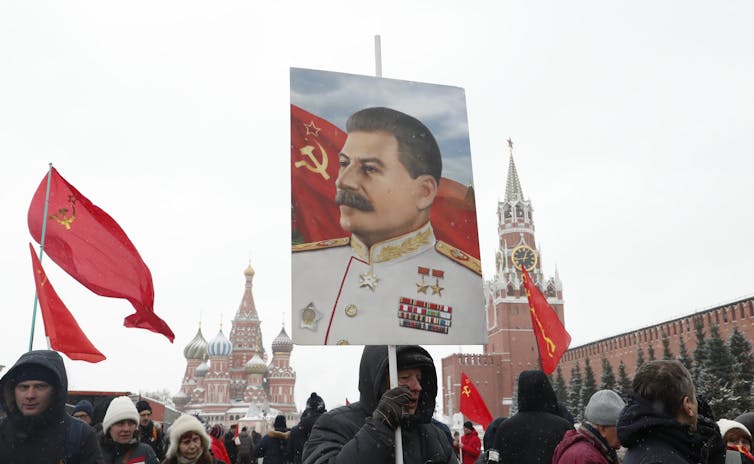 The western allies in the second world war threw their support behind Stalin.
Maxim Shipenkov / EPA
The western allies in the second world war threw their support behind Stalin.
Maxim Shipenkov / EPA
On the fence
The choices the western allies made in the 1940s when they threw their support behind Stalin may have been morally questionable. But they were driven by a keen sense of priorities and a singular focus on defeating what was at the time the gravest threat.
That too is missing today, especially in Trump’s White House. Not only does Trump seem to find it hard to make up his mind whether it is Putin or Zelensky who is to blame for the war and the lack of a peace deal, he also lacks the sense of urgency to give this war his undivided attention.
Worse than that, some of the distractions Trump is pursuing are actively undermining efforts to achieve peace. Threatening to take over Greenland, an autonomous part of staunch US and Nato ally Denmark, hardly sends the message of western unity that Putin needs to hear to bring him to the negotiating table.
Other distractions, like the military operation against Venezuela and the threats of renewed strikes against Iran, create yet more uncertainty and instability in an already volatile world. They stretch American resources and highlight the hypocrisy and double standards that underpin Trump’s America-first approach to foreign policy.
Putin is neither Hitler nor Stalin. But Trump is not comparable to American wartime leaders Roosevelt or Truman either, and there is no strong leader like Churchill in sight in Europe. The war in Ukraine, therefore, is likely to mark a few more milestones of questionable achievement before there might be another opportunity to prove again that aggression never pays.
- Soviet Union (USSR)
- Russia
- Vladimir Putin
- Ukraine
- Nazi Germany
- Donald Trump
- Russia-Ukraine
- Give me perspective
Events
Jobs
-
 Postdoctoral Research Fellow or Research Fellow
-
Research Fellow - AI and Digital Capabilities
-
Data & Reporting Analyst
-
Lecturer/Senior Lecturer, Terrestrial Ecology
-
Video producer
 Postdoctoral Research Fellow or Research Fellow
 Research Fellow - AI and Digital Capabilities
 Data & Reporting Analyst
 Lecturer/Senior Lecturer, Terrestrial Ecology
 Video producer
- Editorial Policies
- Community standards
- Republishing guidelines
- Analytics
- Our feeds
- Get newsletter
- Who we are
- Our charter
- Our team
- Partners and funders
- Resource for media
- Contact us
-
-
-
-
Copyright © 2010–2026, The Conversation