- Home
Edition
Africa Australia Brasil Canada Canada (français) España Europe France Global Indonesia New Zealand United Kingdom United States Edition:
Global
Edition:
Global
- Africa
- Australia
- Brasil
- Canada
- Canada (français)
- España
- Europe
- France
- Indonesia
- New Zealand
- United Kingdom
- United States
Academic rigour, journalistic flair
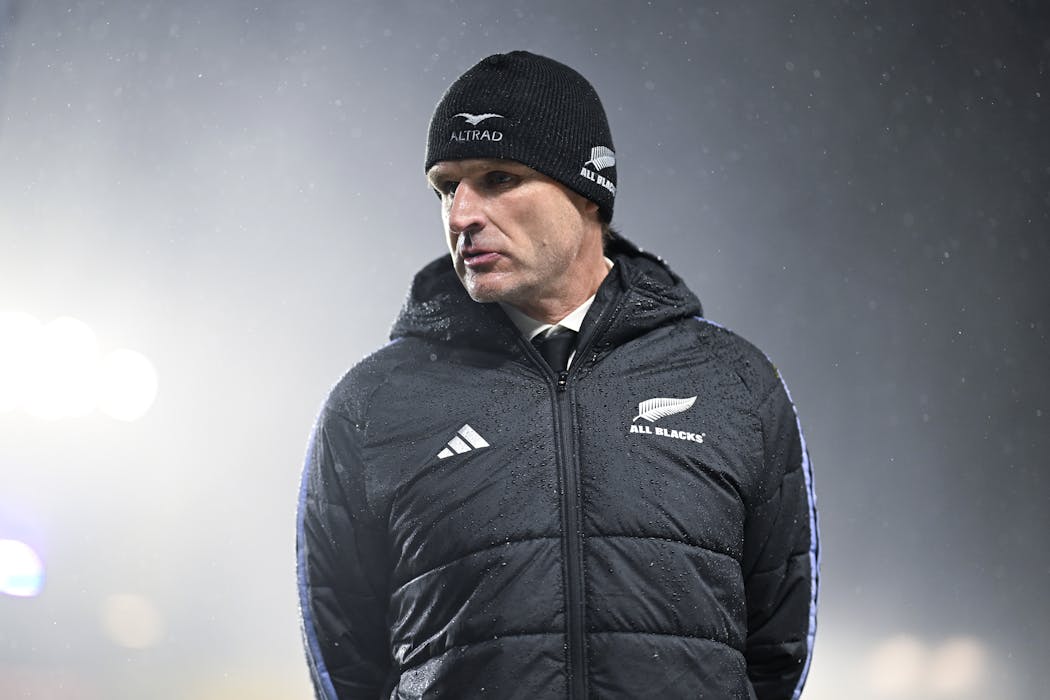
 Hannah Peters/Getty Images
After Scott Robertson, the All Blacks face a deeper question than who coaches next
Published: January 15, 2026 10.41pm GMT
Hoani Smith, Lincoln University, New Zealand, Dion Enari, UNITEC Institute of Technology
Hannah Peters/Getty Images
After Scott Robertson, the All Blacks face a deeper question than who coaches next
Published: January 15, 2026 10.41pm GMT
Hoani Smith, Lincoln University, New Zealand, Dion Enari, UNITEC Institute of Technology
Authors
-
 Hoani Smith
Lecturer in Sport Management and Sport Science, Lincoln University, New Zealand
-
Dion Enari
Associate Professor, Ngā Wai a Te Tūī (Maori and Indigenous Research Centre) and School of Healthcare and Social Practice, UNITEC Institute of Technology
Disclosure statement
The authors do not work for, consult, own shares in or receive funding from any company or organisation that would benefit from this article, and have disclosed no relevant affiliations beyond their academic appointment.
Partners

Lincoln University provides funding as a member of The Conversation NZ.
Lincoln University provides funding as a member of The Conversation AU.
View all partners
DOI
https://doi.org/10.64628/AA.xcqhvfhqf
https://theconversation.com/after-scott-robertson-the-all-blacks-face-a-deeper-question-than-who-coaches-next-273582 https://theconversation.com/after-scott-robertson-the-all-blacks-face-a-deeper-question-than-who-coaches-next-273582 Link copied Share articleShare article
Copy link Email Bluesky Facebook WhatsApp Messenger LinkedIn X (Twitter)Print article
With Scott Robertson’s departure as All Blacks coach, New Zealand Rugby finds itself at a familiar crossroads.
Yet, while coaching appointments come and go in elite sport, this moment demands bigger questions about how the All Blacks should be led.
The immediate conversation will centre on coaching credentials, win-loss records and tactical philosophy. That’s understandable.
But recent player comments suggest the next coaching era may need to think beyond strategy and selection, and pay closer attention to team environment, culture and connection with others.
One of the most telling signs has come from All Blacks veteran Ardie Savea. While playing for Super Rugby franchise Moana Pasifika in 2025, Savea publicly described that time as the happiest he has been in his rugby career.
The comment landed quietly, but its implications are significant. It raises questions about what players experience inside different elite environments, and why a community-rooted franchise might feel more fulfilling than the national team.
It also highlights how the players’ cultural identity and language is important for their ability to perform well on the field.
Savea is not a marginal figure. He is one of the All Blacks’ senior leaders and someone whose reputation has been built on consistency and humility rather than negative publicity.
The All Blacks, as with rugby in Aotearoa more broadly, draw heavily from Māori and Pasifika communities. That is not a political observation, but the demographic reality of the game.
Yet leadership models within elite sport have largely remained grounded in Eurocentric high-performance traditions that emphasise hierarchy and individual resilience.
These models are not inherently wrong. They have produced results for decades. But they prioritise certain ways of being and leading, and often leave less room for relational approaches that place greater emphasis on connection, collective responsibility and holistic wellbeing.
This conversation is already happening within the game. The New Zealand Rugby Players’ Association has publicly called for governance reform, including a stronger understanding of tikanga, te ao Māori and Māori-Pasifika relationships at leadership and decision-making levels.
From a governance perspective, this places responsibility squarely on national sporting organisations.
Why ‘how’ is more important than ‘who’
Reviews, feedback processes and player surveys are standard practice in elite sport. But listening is only one part of the equation. Leadership also involves judgement: weighing player voice, organisational values and long-term goals.
New Zealand netball offers a useful case study. Dame Noeline Taurua was stood down as Silver Ferns coach in 2025 following a review process influenced by player concerns about the environment. The programme struggled for clarity during that period.
When Taurua was later reappointed, the management focus shifted to stability, trust and leadership. The lesson is not that player feedback should be ignored, but that strong systems listen carefully and then lead decisively.
So what do Indigenous and relational approaches prioritise differently?
They tend to place greater value on relationships over hierarchy, collective responsibility over individual compliance, and wellbeing as a foundation for performance rather than a byproduct of it.
These ideas are well established in Māori and Pasifika leadership frameworks outside sport. For athletes, this can translate into a stronger sense of belonging, greater trust in leadership, and environments where honesty is possible without fear of consequence.
Over time, these factors influence not just performance, but retention, leadership development and the credibility of the system itself.
As New Zealand Rugby looks to the next coaching regime, the opportunity is not simply to appoint the most qualified candidate on paper. It is to reflect on whether the system itself is fit for purpose.
New ways of working, informed by Indigenous and relational perspectives, do not need to be viewed as a threat to excellence. Indeed, they may be essential to sustaining it.
Who coaches next will matter. How they lead may matter more. This will be an opportunity to use the best of both western practice and Indigenous knowledge systems to move forward.
- New Zealand
- Sport
- Rugby union
- Elite sport
- Coaching
- All Blacks
- Pasifika
- NZ Rugby
Events
Jobs
-
 Postdoctoral Research Fellow or Research Fellow
-
Research Fellow - AI and Digital Capabilities
-
Data & Reporting Analyst
-
Lecturer/Senior Lecturer, Terrestrial Ecology
-
Video producer
 Postdoctoral Research Fellow or Research Fellow
 Research Fellow - AI and Digital Capabilities
 Data & Reporting Analyst
 Lecturer/Senior Lecturer, Terrestrial Ecology
 Video producer
- Editorial Policies
- Community standards
- Republishing guidelines
- Analytics
- Our feeds
- Get newsletter
- Who we are
- Our charter
- Our team
- Partners and funders
- Resource for media
- Contact us
-
-
-
-
Copyright © 2010–2026, The Conversation